The bet
Every major strategic decision is a bet on execution.
A board can approve the capital. A leadership team can announce the strategy. The real question is whether the organization can absorb it.
Every consequential call runs on noisy inputs against a window that won't wait. Phive reads the risk in the decision before you commit, watches it after you do, and flags trouble while changing course is still manageable one call you can trust, across your organization, and across your systems and sensors.
Read coherence in the organization’s language and reality see where alignment is drifting, well before the cost lands in the numbers.
The same coherence, used live by your machines turning system and sensor signals into a call in the moment it has to be made.
A board can approve the capital. A leadership team can announce the strategy. The real question is whether the organization can absorb it.
Dashboards, engagement scores, town halls, OKRs. They all matter. They also report after the organization has already started to drift.
How well intent, reality, and action stay connected, from the boardroom to the frontline. When it holds, strategy lands. When it breaks, the cost arrives later.
Customer reviews. Employee reviews. Earnings calls. Public filings. News. Social posts. Individually noisy. Together, over time, they reveal patterns.
Trust, clarity, ownership, intent, contradiction, fatigue. Scored through organizational, behavioral, financial, and industry lenses. This is not sentiment analysis.
We keep hearing one thing internally but customers tell us another. Nobody is sure who owns the call.
One number for how well the organization stays connected. High Φ means change gets absorbed with less friction. Low Φ means friction is already accumulating.
Coherence moves first. When alignment breaks, the cost shows up later: margin pressure, delay, and missed growth. Usually about two quarters later.
A business case. A do-nothing baseline. Three genuinely distinct options. Material a leadership team can use to choose, govern, and defend the path. Built in five business days, in the room.
Every new CEO inherits a narrative. Some of it is true. Phive pressure-tests it from the outside, before it hardens into your plan.
Your model assumes a value-realization curve. Phive tests whether the organization can carry that curve. Before close.
Transformations rarely fail on strategy. They fail on absorption. Phive shows whether the organization has the capacity to carry the change.
Most AI strategies are reports. This is a decision room: three tested options, a live workbook, and the governance model that lands it.
Strategic pivots get a five-day read. Your machines don't have five days system signals and sensor feeds need a call in the moment. The same coherence scoring runs live: any input, one engine, a decision at the speed the moment demands.
Across 40+ quarters of testing, Organizational Φ correlated with 52 of 76 financial metrics and moved 2–4 quarters ahead of them. Internal dashboards measure what already happened. Φ measures what is about to.
Coherence scoring only works when the reference base is deep enough to know what normal looks like. Phive's is.
Two working models from the Phive research bench. Every assumption is editable. Every estimate is a range, not a false-precision point.
The free tools are deterministic models, built on analysis across 115,000+ real-world use-case deployments. They show you the general impact. The platform goes further: dozens of bias-guarded models that merge financial analysis, coherence scoring, innovation capacity, and stakeholder mapping around the specific decision on your table.
A first-year ROI estimate built from published adoption benchmarks across 19 industries and 115 role profiles. Honest about what saved time does and doesn’t convert into.
Map your employee mix to 5,401 occupations, score the work at the task level, and get a dollar value pool with a ranked automation roadmap. Deterministic. No black box.
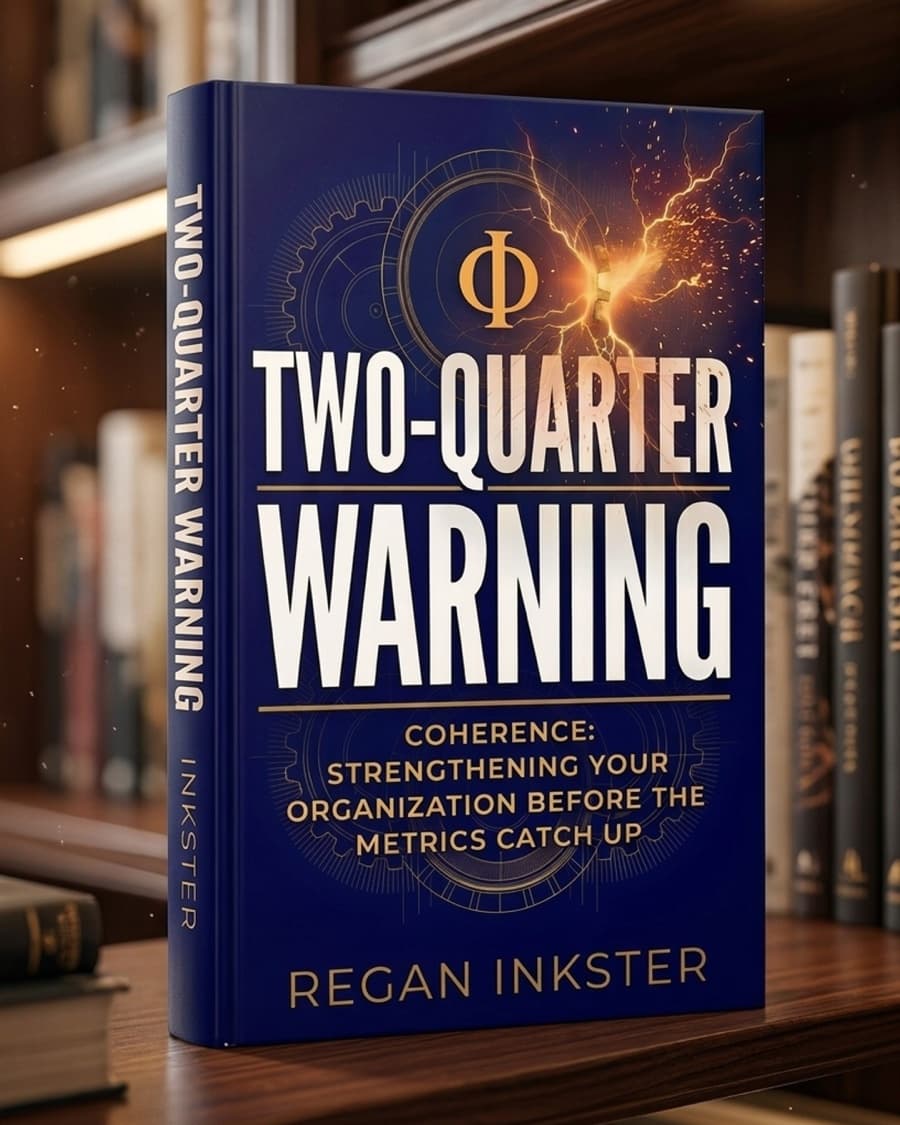
Two-Quarter Warning makes the case behind everything on this page: organizations do not fail suddenly. They fragment quietly. The numbers report it about two quarters later. The book shows how to read the signal, and how to act on it while acting is still cheap.
It is out now in paperback, hardcover and a Kindle edition.
We respond within one business day. A scoped proposal or a short conversation, whichever fits the window.